WhatsApp Voice Message Automation | Complete Guide
Send automated voice messages to customers via WhatsApp. Learn supported scenarios and technical limitations.
WhatsApp Voice Messages: An Untapped Business Tool
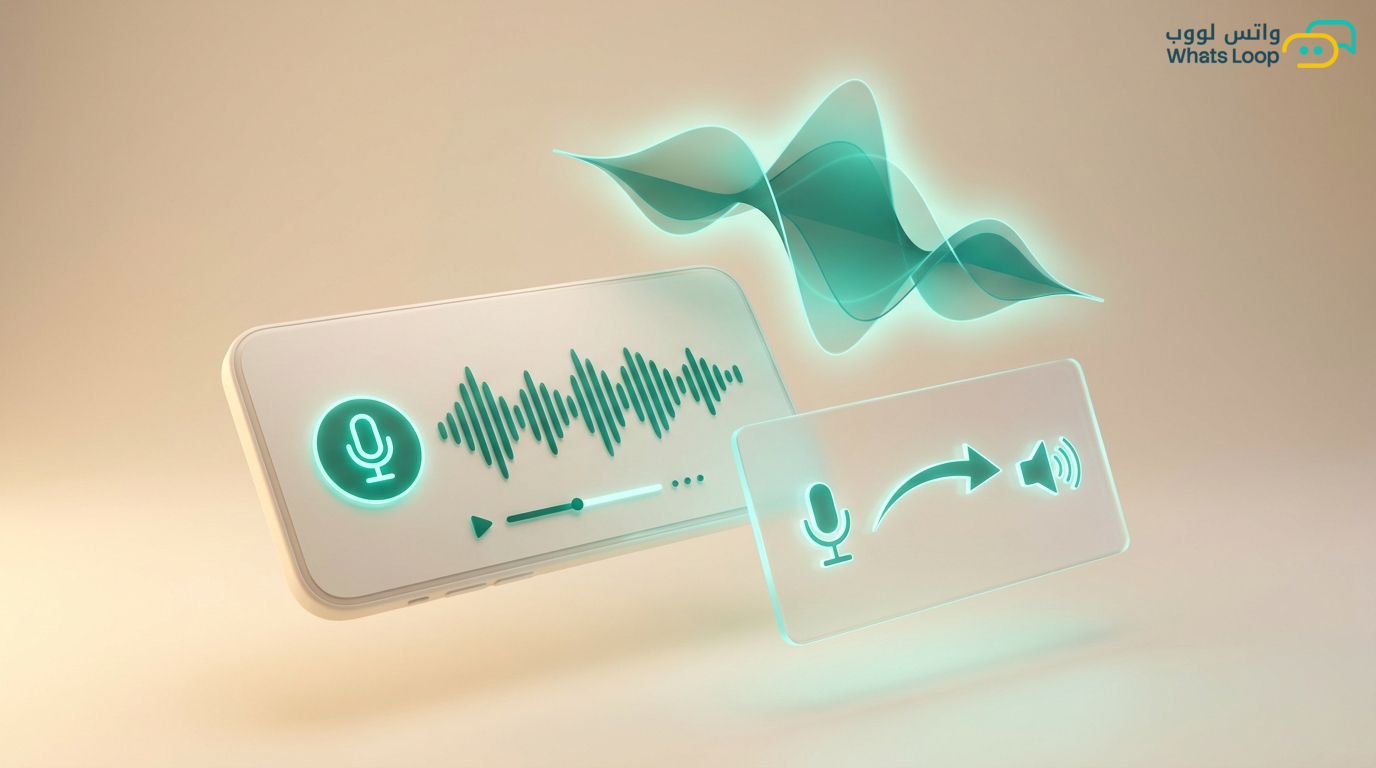
Voice messages on WhatsApp are used by a significant portion of users daily, yet in the business world they remain completely neglected and underutilized. Most companies treat WhatsApp as a text-only channel: sending text messages, templates, images, and PDFs while completely ignoring the fact that their customers prefer voice because it is faster, easier, and more expressive. In Saudi Arabia specifically, the culture is fundamentally oral and a voice message feels closer to the customer than any written text no matter how carefully crafted it might be.
The irony is that Text-to-Speech (TTS) and Speech-to-Text (STT) technologies have improved dramatically in 2025 and 2026. Models like OpenAI's Whisper achieve very high accuracy in Saudi and Gulf dialects, and services like ElevenLabs and Google Cloud TTS generate natural Arabic voices that are nearly indistinguishable from real human speech. This means you can today build an automation system that receives voice messages from your customers, understands them, and responds with voice, all automatically and at high quality.
Why Voice Outperforms Text in Customer Service
The data is clear, convincing, and indisputable. Voice message open rate on WhatsApp is significantly higher than text messages and email. The reason is both psychological and practical at the same time: voice carries tone, warmth, and emotions that text can never convey. When your customer hears a friendly voice message in their dialect saying "Hello Abu Mohammed, your order is ready and will arrive today before sunset, God willing," the impact is completely different from a cold text message reading "Order #4521 in transit."
Companies that added voice messaging to customer service channels saw:
- Notable customer satisfaction increase compared to text-only service
- Problem resolution time decrease because customers explain their issues verbally with more detail and faster than typing
- Customer response rate increase especially in follow-up and reminder messages
- Cancellation and return rate decrease when order confirmations are sent via voice instead of text
How Voice Message Automation Works Technically
The system consists of three stages working in perfect coordination and seamless flow:
Stage One: Reception and Conversion: The customer sends a voice message via WhatsApp in their language and natural manner. The system receives the audio file (OGG/Opus) and converts it to text through an AI-powered Speech-to-Text engine. Conversion supports Saudi, Egyptian, Levantine, Lebanese, and Moroccan dialects, all with high accuracy. The system also automatically detects the speaker's language and processes each language with the appropriate model.
Stage Two: Understanding and Processing: The converted text enters an AI model that understands the request and identifies intent (order status, complaint, product inquiry, appointment request). The model pulls required data from connected systems (CRM, order system, inventory) and prepares an appropriate response in the customer's language and dialect. If the customer spoke Saudi, the response comes in Saudi dialect. If they spoke Egyptian, the response comes in Egyptian dialect. This dialect-level customization creates a sense of closeness and credibility that no written text can achieve.
Stage Three: Generation and Sending: The prepared text response is converted to a voice message through a Text-to-Speech engine with a natural, appropriate voice. You can choose a male or female voice based on the nature of your business, and adjust speech speed and voice tone. The voice message is automatically sent to the customer via WhatsApp as a regular voice message, the customer sees it as any voice message from a real person. Total time from receiving the customer's message to sending the response: 8-15 seconds only.
Practical Application Scenarios in the Saudi Market
Restaurant or cafe: Customer sends a voice message "I want to book a table for four people on Thursday at 8 PM." The system automatically understands the request (booking, 4 people, Thursday, 8 PM), checks the schedule, and responds with voice: "Your table is booked Abu Fahad, four people Thursday at eight PM. We will send you a reminder two hours before. Would you like to add any special notes?" This saves the restaurant the cost of an employee answering calls and gives the customer a fast, comfortable voice experience they prefer.
Medical clinic: A patient sends a voice message describing symptoms and requesting an appointment. The system converts voice to text, extracts basic medical information (symptom type, duration, severity), suggests the appropriate specialty and available doctors, and sends a voice message with available appointments. The patient responds with voice choosing the convenient time and booking is confirmed automatically.
Real estate agency: A customer sends a voice message describing the apartment or villa they are looking for. The system understands the specifications (neighborhood, area, budget, number of rooms), searches the property database, and sends personalized voice messages about the three closest matching properties with details of each one.
Corporate customer service: A customer sends a voice complaint about a bad experience with a product or service. The system receives and analyzes the complaint, determining urgency and emotion (angry, frustrated, calm). If the customer is very angry, the system transfers immediately to a specialized human employee with a complete problem summary. If the complaint is simple with an obvious solution, it responds with voice providing the solution and follows up.
Essential Tools and Technologies for Implementation
| Tool | Use | Arabic Accuracy | Cost |
|---|---|---|---|
| OpenAI Whisper | Speech to text | High accuracy in Saudi dialects | Free (open source) |
| Google Cloud STT | Speech to text | High accuracy with multi-dialect support | Per usage |
| ElevenLabs | Text to speech | Natural Arabic voices | Monthly subscription |
| Amazon Polly | Text to speech | Multiple Arabic voices | Per usage |
| Azure Speech | Bidirectional | High accuracy | Per usage |
Real Challenges and Proven Solutions
Background noise challenge: Customer sends a voice message from a noisy environment, busy street or family gathering. Solution: use Speech-to-Text models trained on noise like Whisper Large V3 that automatically isolates human voice. Conversion accuracy in noisy environments is slightly lower than quiet environments, a perfectly acceptable gap for commercial use.
Multiple dialect challenge: Saudi Arabia has different dialects: Najdi, Hijazi, Northern, Southern. Customers may also be of different nationalities with Egyptian, Levantine, and Moroccan dialects. Solution: use multi-dialect models with an automatic dialect detector that identifies the speaker's dialect in the first 3 seconds and selects the most appropriate model for conversion.
Privacy and security challenge: Voice messages contain a unique voiceprint considered sensitive personal data under Saudi PDPL. Solution: encrypt audio files during transit and storage, delete original audio files after text conversion, retain only the converted text with a reference to the original voice message's existence. This practice achieves the balance between functionality and protecting customer privacy.
Roadmap: From Zero to Complete Voice System in 30 Days
Week One: Infrastructure setup: connect WhatsApp API with WhatsLoop, activate voice message reception, set up Whisper engine for conversion, and test accuracy with real samples from your actual customer messages.
Week Two: Build processing logic: design decision paths based on voice request type, connect with CRM and order system, and set up escalation rules for human employees when strong negative emotions or complex requests are detected.
Week Three: Activate voice response: choose a TTS voice that fits your brand, test with a limited group of actual customers, and collect their feedback in an organized manner.
Week Four: Full launch and monitoring: activate the system for all customers while monitoring conversion accuracy, customer satisfaction, and escalation rate daily, adjusting settings based on actual data.
Success Metrics You Must Track
- Voice conversion accuracy: Target high accuracy in Saudi dialect
- Total response time: Under 15 seconds from receiving voice to sending response
- Customer satisfaction with voice experience: 4.2+ out of 5
- Percentage of voice messages successfully auto-processed: Majority of messages
- Cost per processed voice message: Low per-message cost
Sign up for WhatsLoop and be among the first companies to offer intelligent voice customer service through WhatsApp, because your customers prefer speaking over typing.
Frequently Asked Questions
Q: Does WhatsApp voice message automation support different Arabic dialects like Saudi and Egyptian? A: Yes, speech-to-text engines like Whisper support Saudi dialects (Najdi, Hijazi), Egyptian, Levantine, and Moroccan with high accuracy. The system automatically detects the speaker's dialect within the first few seconds and selects the most appropriate model for conversion.
Q: How long does it take for the automated voice reply to reach the customer on WhatsApp? A: The total time from receiving the customer's voice message to sending the voice reply ranges from 8 to 15 seconds only. This includes converting voice to text, understanding and processing the request, and converting the reply into a natural-sounding voice message.
Q: Do automated WhatsApp voice messages comply with Saudi Personal Data Protection Law (PDPL) standards? A: Yes, provided proper practices are implemented: encrypting audio files during transit and storage, deleting original audio files after text conversion, and retaining only the converted text. WhatsLoop applies these practices automatically to protect customer data privacy.
Q: What are the main use cases for voice message automation for businesses in Saudi Arabia? A: Key use cases include restaurants receiving booking requests via voice, medical clinics understanding patient symptoms and scheduling appointments, real estate agencies capturing client requirements, and customer service departments analyzing and classifying voice complaints by urgency level automatically.