WhatsApp AI Agents | Autonomous Bots That Decide and Execute
Next-gen WhatsApp bots go beyond replies, they analyze, decide, and complete tasks autonomously.
From Chatbots to AI Agents: The Next Generation of WhatsApp Automation
Traditional WhatsApp bots run on simple, limited logic: if the customer types "1" send the menu, type "2" transfer to an agent, anything else send "Sorry, I did not understand your request." AI Agents are fundamentally different from these basic bots: they are intelligent systems that understand the full context of a conversation, make decisions based on actual rules and real data, and execute multiple sequential tasks without requiring human intervention at every step. A bot follows a pre-written script and stops or gets confused when the customer deviates from it. An agent thinks and acts based on the actual situation and the customer's complete history with your business.
Most companies that adopted AI agents saw measurable improvement in customer satisfaction within a short period. The reason is direct and clear: the agent resolves the customer's request completely from start to finish without transferring between different departments and without the customer repeating their problem to every new employee they talk to.
Practical Example, Returning a Product: Bot vs. Agent
A traditional bot needs 6 slow and frustrating steps: displays a fixed menu that never changes, customer selects "Return a product," bot sends an external form link on another website, customer leaves WhatsApp and fills out the form and waits, employee manually reviews the request after hours or a full day, and the customer contacts again asking about the return status and has to explain everything from the beginning.
An AI Agent completes the same task in a completely different way in just 90 seconds: the customer writes in their natural language "I want to return the phone I bought yesterday: there is a scratch on the screen and it does not work properly," the agent understands three key pieces of information (request: return, product: phone, reason: manufacturing defect), automatically pulls order data from the system, checks the return policy (within 7 days, product eligible, defect is manufacturing), auto-approves because the amount is below the automatic approval threshold, generates a PDF shipping label and sends it with packaging instructions, updates inventory, accounting, and the CRM record, and sends a clear confirmation: "Your return has been accepted. Shipping label attached. The amount will be refunded within 3-5 business days." All in one conversation, no external forms, no follow-up needed.
The Four Core Capabilities of AI Agents
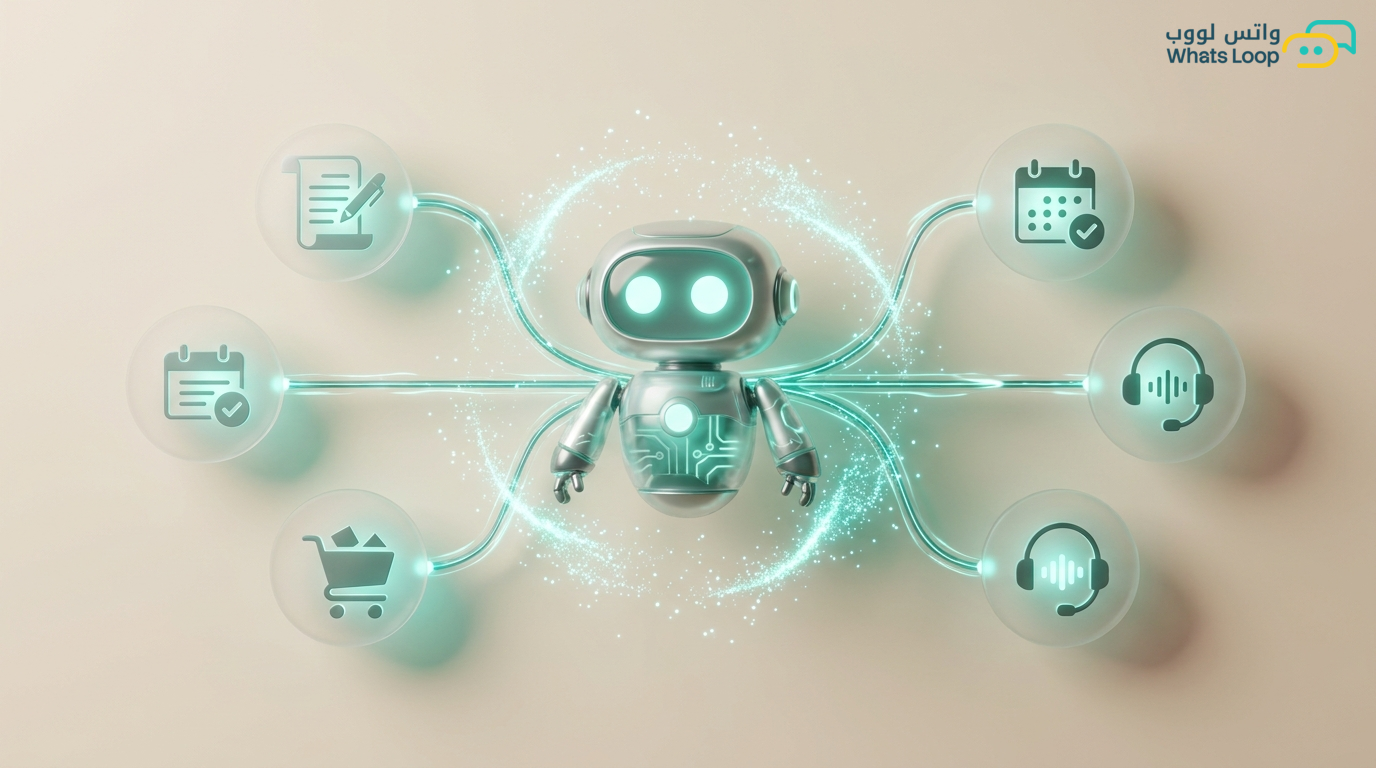
AI Agents stand apart from regular bots through four core capabilities that put them in an entirely different league:
- Cumulative context understanding: The agent remembers all of the customer's previous conversations, connects them to the current one, and uses them to deliver better and smarter service. If a customer complained about a shipping delay last week, the agent automatically knows and handles any new contact with greater sensitivity: apologizes for the previous experience, prioritizes the new order, and offers compensation if the rules allow it
- Rule-based decision-making: Based on rules you pre-define with clarity, the agent can approve a special discount, process a full return, escalate to a supervisor when needed, issue a compensation voucher, or politely deny with a clear explanation, all without waiting for anyone to approve. You define the boundaries and policies and it operates within them with total discipline
- Sequential and complex task execution: The agent does not just send a text reply: it accesses the order system and modifies data, updates CRM with notes and the new status, sends a confirmation email to the customer and a copy to the manager, schedules a follow-up task for 3 days later, and generates a daily report of handled cases. Each task executes in the correct sequence without errors
- Continuous learning and improvement: Every conversation makes it smarter. It identifies the most frequently asked questions and prepares faster responses. It recognizes common problem patterns and suggests proactive solutions before the customer even asks. Over months, it becomes noticeably faster, more accurate, and more effective
Real Applications from the Saudi Market
In Saudi Arabia specifically, AI agents are already changing how entire sectors operate and delivering tangible financial results:
E-commerce: Stores on Salla and Zid use AI agents to automatically handle most post-sale inquiries: order status, address changes, invoice requests, product complaints, size exchange requests. Human employees now focus exclusively on complex and exceptional cases that truly require human intervention. Direct financial result: significant savings in support team costs while customer satisfaction improved simultaneously.
Healthcare: Clinics and medical centers in Riyadh and Jeddah use AI agents to manage the complete appointment lifecycle: initial booking, 48-hour confirmation, 3-hour reminder, and rescheduling when needed. The agent verifies the patient's insurance coverage, knows which doctors are available in the required specialty, and suggests appropriate alternatives. Result: significant reduction in appointment no-shows and notable increase in total bookings.
Real estate: Large property companies use AI agents that intelligently filter and qualify potential customers with professionalism. The agent naturally and comfortably asks about available budget, preferred geographic location, required area, number of rooms, and expected move-in date. It automatically classifies customers (serious and ready to buy, exploring and searching for options, investor looking for returns) and forwards only serious customers to the sales team with a complete detailed summary of their needs. Practical result: the sales team focuses their time and effort on the serious customers who actually represent the majority of sales.
Restaurants and delivery: AI agent takes food orders naturally through conversation, suggests items based on the customer's previous orders ("Have you tried the new pizza? Customers loved it"), handles all modifications flexibly ("no onions," "extra spicy," "half portion"), and automatically calculates the final bill including delivery and tax. WhatsApp order volume increased significantly in restaurants that activated AI agents because the process became easier and faster than using the app.
Building an Effective AI Agent: 5 Proven Practical Steps
- Define scope with extreme precision: Do not try to make the agent do everything from the start, this is the biggest mistake you can make. Start with one specific task and ensure it works with very high accuracy, then expand gradually each month. Companies starting with everything at once usually succeed at nothing
- Design decision rules with complete clarity: Define in detail: when does the agent auto-approve? When does it deny with an explanation? When does it request employee approval? When does it escalate to a manager? What is the maximum amount it can approve? Clear written rules equal fewer errors and fewer legal issues
- Connect all actual systems: Order system, CRM, inventory, billing, appointments. Without real connections to actual systems, it becomes just a smart bot with no tools. Every unconnected system is an obvious gap in the agent's capability
- Test with real and extreme scenarios: Have real employees act as difficult customers and try to confuse the agent with unexpected questions, weird requests, colloquial language, and awkward situations
- Monitor and improve continuously: First two weeks after launch, review all conversations and correct any error immediately. Then focus on exceptional cases the agent could not handle, these cases are your golden opportunity for continuous improvement
Real Risks and How to Avoid Them
- Over-trust: Do not give the agent authority to process large refunds without explicit human approval. Set a clear, documented ceiling: for example, auto-approve any return under 500 SAR, anything larger requires manager approval after review
- Hallucinated responses: This is the most dangerous problem. Train the agent to say "I do not have confirmed information about this topic, let me transfer you to my specialist colleague" instead of inventing a wrong answer. An AI that honestly acknowledges its limits is far better than one that hallucinates and fabricates
- Customer data leaks: Every conversation must operate in a completely isolated space, fully separate from all other conversations. Never share one customer's data with another under any circumstances
- Losing the human touch: Some sensitive human situations (a grieving customer, a serious complaint threatening your reputation, a situation requiring genuine empathy) need a real human to handle them. Train the agent to recognize these situations and immediately transfer the conversation to the best available employee
AI Agent Success Metrics You Should Track Weekly
| Metric | Logical Target |
|---|---|
| Full resolution rate without human intervention | High |
| Average resolution time per conversation | Under 2 minutes |
| Customer satisfaction with agent experience (CSAT) | 4.3+ out of 5 |
| Escalation rate to human employee | Low |
| Response and information accuracy | Very high |
| Complaint rate specifically about agent responses | Very low |
Get Started with AI Agents on WhatsLoop
WhatsLoop gives you all the tools you need to build advanced and effective AI agents: smart bots with advanced natural language understanding capabilities, direct API integration with your existing systems, advanced automation with flexible and adjustable decision rules, and detailed performance reports that give you complete visibility into agent performance. Everything from one easy-to-use Arabic dashboard.
Sign up for WhatsLoop and transform your WhatsApp from a simple communication channel into an intelligent business agent that executes and decides instead of just replying and transferring.
Frequently Asked Questions
Q: What is the core difference between a traditional WhatsApp chatbot and an AI agent for customer service? A: A traditional chatbot follows a fixed pre-written script and breaks down when the customer deviates from the expected path. An AI agent understands the full conversation context, connects information from different systems, and makes decisions based on actual rules and data, it can process a complete return request or resolve a complex issue without human intervention.
Q: Are WhatsApp AI agents safe for handling sensitive customer data and financial operations? A: Yes, provided permissions are configured correctly. Best practice is setting clear thresholds for automatic financial operations and requiring human approval for large amounts. WhatsLoop provides a flexible permissions system that gives you granular control over what the agent can execute automatically versus what requires approval.
Q: How long does it take to build and activate an effective AI agent on WhatsApp for a Saudi e-commerce store? A: Initial setup typically takes about two weeks, one week for configuration and system integration and one week for testing and optimization. However, effectiveness improves over time as the agent learns from every conversation. The best approach is starting with one specific task and gradually expanding capabilities each month.
Q: Can a WhatsApp AI agent understand Saudi dialect and interact naturally with it? A: Yes, modern AI models used in 2026 understand different Saudi dialects (Najdi, Hijazi, Northern) with high accuracy. The agent can understand requests written in colloquial Arabic and respond in the same dialect or in formal Arabic depending on how you configure its settings.