Advanced WhatsApp Customer Segmentation Strategies
Segment customers by behavior, purchases, and engagement. Personalized messages achieve 3x higher conversions.

Smart Segmentation: Speaking to Each Customer in a Way That Fits Them Perfectly
Sending the same message to all your customers is the worst possible strategy in 2026. The majority of customers expect personalized communication and feel genuine frustration when receiving generic messages irrelevant to them. Advanced segmentation means dividing your customer base into precise groups based on their actual behavior and real data, then sending tailored messages to each group that speak their language and address their specific needs.
The difference between basic and advanced segmentation is stark: basic segmentation divides customers by static data: city, gender, age. Advanced segmentation uses actual behavior: purchase history, interaction frequency, customer lifetime value (LTV), current purchase stage, browsing patterns, response to previous campaigns, and message open rates. In Saudi Arabia, companies using advanced segmentation in WhatsApp campaigns achieve significantly higher ROI than companies sending generic messages to everyone.
The Five Segmentation Layers: From Basic to Advanced
Layer One: Demographic (Who is the customer): City, gender, age group, preferred language (Arabic or English). This information is essential but alone is never enough. Knowing a customer is from Riyadh tells you nothing about their readiness to buy or actual interests, Riyadh has millions of people with millions of different needs.
Layer Two: Behavioral (What does the customer do): Number of store or website visits, products actually viewed and browsed, abandoned carts with their value and frequency, completed orders and total value, return and exchange rate, preferred activity times (morning, afternoon, evening, night). This behavioral data gives you a clear, actual picture of each customer's interests and precisely determines what they are really looking for and when they are most ready to engage and buy.
Layer Three: Value (How much is the customer worth): Enhanced classic RFM classification: Recency (when they last purchased), Frequency (how often they purchase), Monetary value (how much they have spent in total). These three factors combined determine the customer's true value and tell you precisely where to invest your time and marketing budget. A customer who bought 5 times in the last 3 months totaling 5,000 SAR deserves completely different attention and messages than a customer who bought once a year ago for 200 SAR.
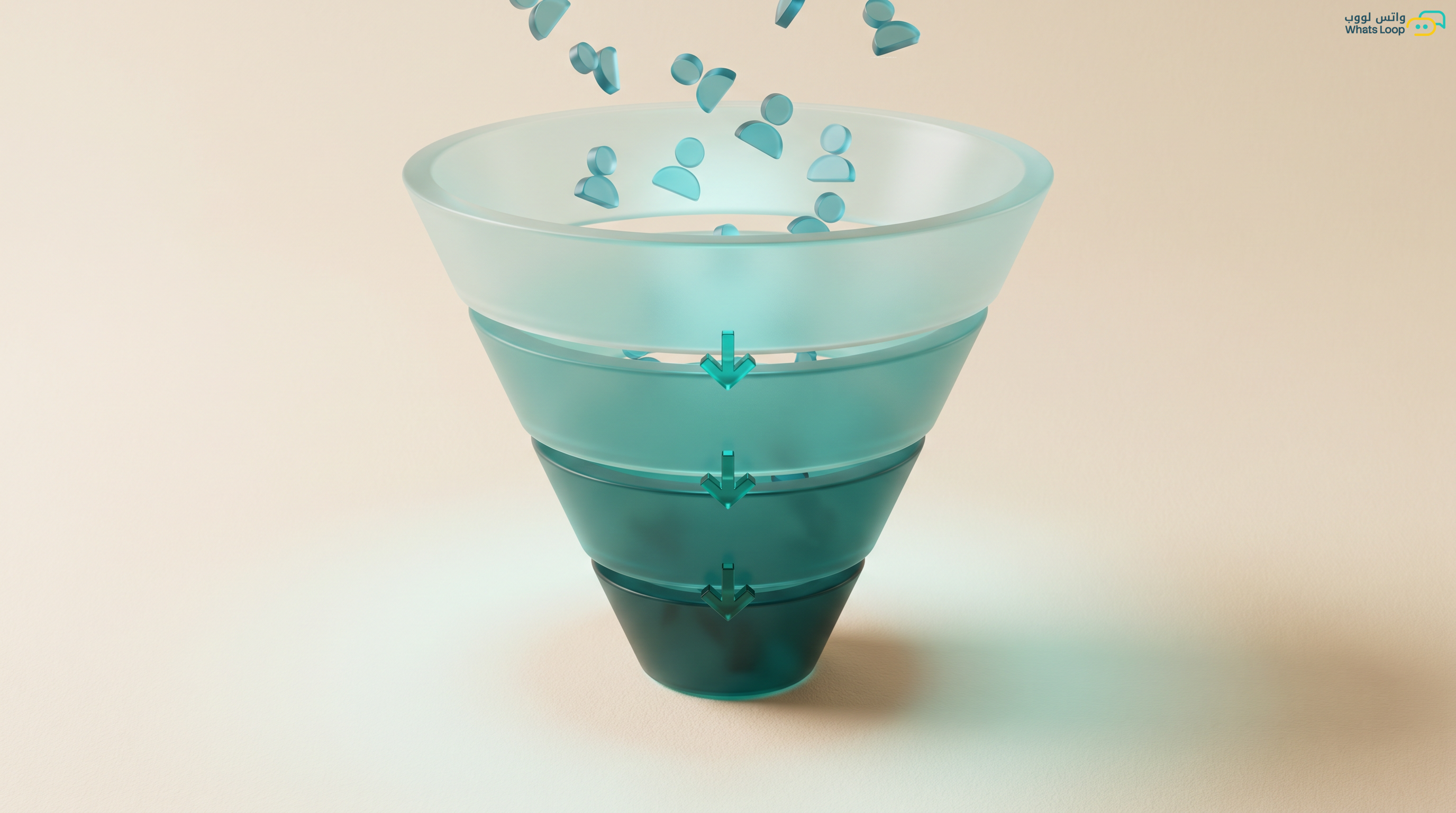
Layer Four: Journey stage (Where is the customer now): Is the customer new and has not bought yet (exploration stage)? Bought once (trial stage)? A regular repeat customer (loyalty stage)? Suddenly stopped buying (risk stage)? Completely disappeared for over 90 days (loss stage)? Each stage requires a radically different communication strategy with different tone, content, and incentives.
Layer Five: Predictive (What will the customer do): Using AI algorithms and historical behavior pattern analysis, you can predict with acceptable accuracy: who will buy within the next week? Who is at risk of leaving? What product will each customer be interested in? What is their expected purchase value over the next 12 months? Predictive segmentation lets you act proactively instead of being reactive.
Customized Message Strategies for Each Segment
New customers (have not bought yet): Personal welcome message within the first 24 hours of registration. Special first-purchase offer, 15% discount or free delivery. An introductory series of 3 messages over a week: the first introduces top products and services, the second shares a success story from a similar Saudi customer, the third presents a limited-time offer with a countdown. Expected conversion rate from this series is notably higher compared to generic messages.
Repeat customers (3+ orders): Smart messages about products complementary to their previous purchases: if they bought running shoes, send an offer on athletic socks or a gym bag. Invitation to a loyalty or rewards program if available. Exclusive early access to new products or seasonal offers 48 hours before the general public. This segment typically represents a small percentage of customers but contributes the majority of revenue, invest in them without hesitation.
At-risk customers (stopped buying): A "we miss you" message 30 days after last interaction with an exclusive 20% discount valid for only 72 hours. After 60 days, a second message asking if there is an issue or reason for stopping with a quick survey link. After 90 days, a final strong and compelling offer, "last chance" with a 30% discount for 48 hours. Reactivating an existing customer costs significantly less than acquiring a completely new one.
Highest-value customers (VIP): Personalized communication from a named account manager: "Hello Abu Sultan, I am Khalid from WhatsLoop. If you need anything, message me directly." Exclusive access and priority in service and support. Surprise gifts on personal occasions: birthday, first order anniversary, holidays. These customers deserve significantly more investment than a regular customer because their returns easily justify it.
Common Segmentation Mistakes and Corrections
| Mistake | Problem | Solution |
|---|---|---|
| Too many segments | Segments too small, too many messages to manage | 5-8 main segments sufficient for start |
| Static segmentation without updates | Customer changes over time and their segment changes | Automatic weekly update based on latest behavior |
| Ignoring timing | Excellent message at wrong time equals poor results | Analyze activity times per segment and send at peak |
| Same offer for all segments | 10% discount does not motivate VIP and does not fit new customer | Customized offers based on customer value and history |
| Not measuring results | You do not know which segment responds and which does not | Track open, click, and conversion rates per segment |
Practical Example: Ramadan Campaign with Smart Segmentation
Instead of sending "Ramadan offers, 20% off everything" to your entire customer base (the traditional approach everyone uses), use smart segmentation to achieve doubled results:
- Food product customers: "Prepare your Ramadan table, Premium Madinah Ajwa dates have arrived. Order before Asr for delivery before Iftar"
- Electronics customers: "Ramadan offer: 65-inch TV with a free soundbar. Perfect for watching Ramadan series"
- New customers: "First Ramadan with us! Use code RAMADAN15 for 15% off plus free delivery"
- VIP customers: "Abu Fahad, we prepared an exclusive Ramadan basket with products selected especially for you. Delivered to your home at the start of Ramadan. A gift from us to our valued customers"
- Churned customers: "We miss you! Your return to us in Ramadan is sweeter. Your gift: 25% off any order during the first week of Ramadan"
Actual measured result: a Ramadan campaign with smart segmentation achieves significantly higher return than a generic campaign with the same budget, time, and effort.
How WhatsLoop Helps You with Advanced Segmentation
WhatsLoop provides built-in advanced segmentation tools that work automatically and integrate with every part of the platform:
- Automatic behavior-based segmentation: The system automatically tracks every interaction and classifies customers without manual intervention from you
- Advanced flexible filters: Combine multiple criteria together: "Riyadh customers who bought more than twice, last purchase within 30 days, total value over 1,000 SAR"
- Dynamic updates: Segments update automatically with every new interaction from any customer, you never need to manually re-segment
- Performance reports per segment: View open, click, conversion, and unsubscribe rates for each segment separately and make decisions based on actual data
- Segment-linked automation: Create different automation flows that trigger automatically based on segment, a new customer enters a welcome flow, an at-risk customer enters a recovery flow
Sign up for WhatsLoop and start with smart segmentation, because the right message to the right customer at the right time is the difference between a successful campaign and an annoying one.
Frequently Asked Questions
Q: What is advanced customer segmentation in WhatsApp and how does it differ from basic segmentation? A: Basic segmentation relies on static data like city, gender, and age. Advanced segmentation uses actual customer behavior: purchase history, interaction frequency, total value, current purchase stage, and message open rates. WhatsLoop provides five segmentation layers from demographic to predictive that work automatically without manual intervention.
Q: How many customer segments should you create when starting smart segmentation for WhatsApp campaigns? A: It is recommended to start with 5 to 8 main segments, more means segments become too small to manage and too many messages to prepare. Core segments include new customers, repeat customers, VIP customers, at-risk customers, and churned customers. Once you master these segments, expand gradually.
Q: Does smart segmentation actually improve WhatsApp bulk campaign ROI compared to sending to everyone? A: Yes, segmented campaigns achieve returns multiple times higher than generic campaigns with the same budget. The reason is that each segment receives a customized message matching their situation, a recovery offer for churned customers, early access to new products for VIP customers, and a first-purchase discount for new customers.
Q: Does WhatsLoop automatically update customer segments with every new interaction? A: Yes, segments in WhatsLoop are dynamic and update automatically with every new customer interaction. When a customer makes their third purchase, they automatically move to the repeat customers segment, and when a customer stops engaging for 30 days, they move to the at-risk segment. You never need to manually re-segment.